A 10-minute payday method
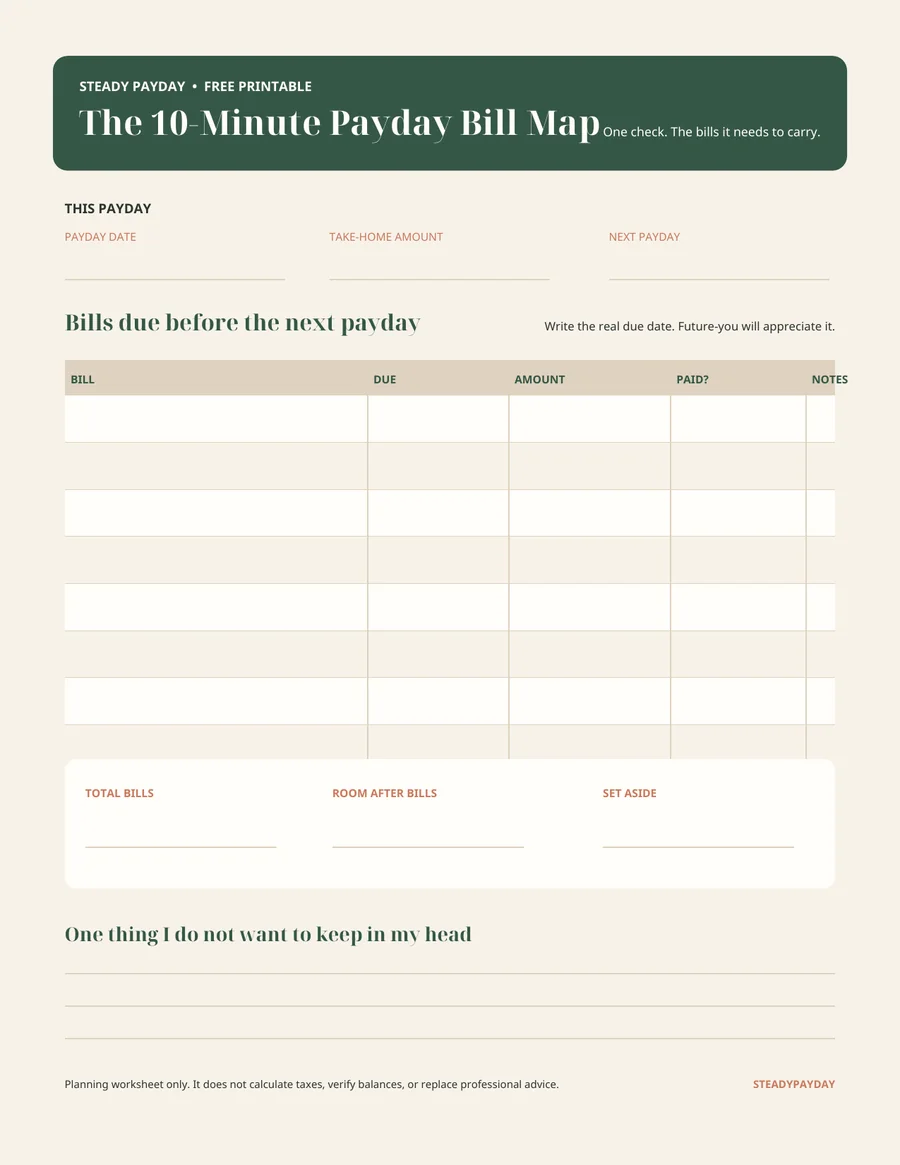
Build a biweekly paycheck bill calendar.
A monthly budget tells you what the month costs. A payday bill calendar answers the timing question: which check needs to carry which bill?
Use actual due dates and known take-home deposits where possible. Keep estimates labeled as estimates. This is a planning method—not a balance checker, payroll calculator, or promise that the numbers will fit.
One-page PDF · no email gate · print or write on it digitally
The useful distinction
Monthly totals and payday timing are different jobs.
A monthly budget asks
What income and expenses belong to this month?
A payday bill calendar asks
What must be ready between this deposit and the next one?
You may need both. The calendar view is especially useful when pay arrives every other week, due dates cluster together, or shift hours make one deposit different from the next.
The five-step setup
Map two paydays before assigning the first bill.
-
Mark the next two or three paydays.
Write each deposit date. Add the known take-home amount from a recent paystub or deposit record when it is available. If the amount is only an estimate, label it clearly; estimated gross income is not the same as spendable cash.
-
Copy bills from current records.
List the bill, due date, and statement or expected amount. Include obligations that are easy to forget because they are not monthly. Do not rely on memory when the account or statement can give you the current date and amount.
-
Assign each bill to an earlier payday.
Place the bill under a check that arrives before the due date, with room for the payment method to process. A bill due on the 12th usually belongs with the payday that clears before the 12th—not whichever check looks less crowded.
-
Inspect the handoff to the next check.
Look for a payday carrying too many dated obligations while the next one carries very few. Flag the gap. Moving a planned payment is only appropriate when the biller's actual terms allow it; the calendar does not change a contract or due date.
-
Reset with the actual deposit.
After payday, replace any estimate with what actually arrived and mark what was paid. Then roll the view forward so you can still see the next two paydays instead of starting over at the end of the month.
A fictional timing example
The due date chooses the starting lane.
Suppose paydays land on Friday the 4th and Friday the 18th. The amounts below are deliberately omitted—the method works from your real records, not a generic income assumption.
Payday · Friday the 4th
- RentDue 1st of next month
- PhoneDue 10th
- InsuranceDue 16th
Payday · Friday the 18th
- PowerDue 22nd
- InternetDue 26th
- Next-month handoffReview before spending
This example illustrates timing only. It does not tell you which obligations to prioritize or whether changing a payment date is permitted.
The three-paycheck month
A third check is not automatically “extra.”
A biweekly schedule often creates two three-paycheck months in a year; some calendar alignments create a third. The exact months depend on your payday sequence and the calendar year. Before giving the third check a special job, map the bills due before the following payday. The month boundary can make part of that deposit responsible for next month's obligations.
When checks vary
Keep planned, estimated, and actual amounts separate.
- Planned: the amount you intend to assign to a bill or purpose.
- Estimated: a tentative pay or bill amount that still needs confirmation.
- Actual: the deposited take-home amount or current statement amount.
- Authoritative record: the paystub, account, statement, or employer/biller information that controls—not the worksheet.
For shift work or irregular income, record premium hours and estimated pay separately from the actual deposit. The worksheet can organize what you know; it cannot interpret employer policy, deductions, taxes, or payroll rules. For a deposit-by-deposit workflow, use the five-step irregular-paycheck budget method.
Quick answers
Biweekly bill-calendar FAQ
Should every bill go under the nearest payday?
Not necessarily. Start with the payday that arrives early enough for the bill's real due date and payment-processing time. Then inspect whether the full set of assignments fits your actual deposits.
What if a bill is due before the first payday shown?
That obligation belongs to the prior payday window or needs separate attention. Do not make it disappear by placing it after its due date on the worksheet.
Can I use this with weekly, semimonthly, or irregular pay?
Yes—the core method is date-based. Replace the two-week rhythm with your actual deposit dates and keep enough upcoming paydays visible to cover the next due-date window.
Does the worksheet calculate what I can afford?
No. It organizes dates and amounts you enter. It does not verify balances, calculate taxes, interpret payroll, or replace professional advice.
Choose the amount of structure you need